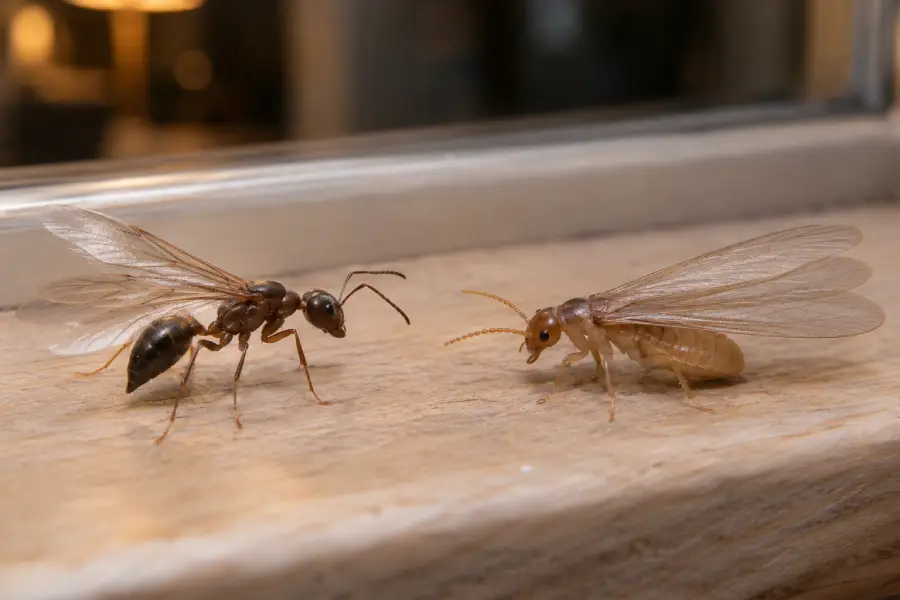
Check three things on the insect itself: the antennae, the waist and the wings. Flying ants have elbowed antennae, a pinched waist and front wings longer than the back pair. Flying termites have straight, bead-like antennae, a thick body with no waist and four wings of equal length. The Australian Museum uses the same features to separate the two groups.
A cloud of winged insects around a light, or a pile of wings on a windowsill, looks alarming because the two insects look alike at a glance. Working out which one you have decides whether you need to book a termite inspection or can simply sweep up.
The one-minute check
| Feature | Flying ant | Flying termite |
|---|---|---|
| Antennae | Bent, like an elbow | Straight, a string of beads |
| Waist | Pinched between middle and rear | Thick body, no pinch |
| Wings | Front pair longer than back pair, clear veins | Four wings of equal length, few visible veins |
| Rear of the body | Pointed | Blunt |
Where and when you might see them
Winged termites leave the nest to start new colonies, usually in warm, humid weather. They are drawn to light, so people tend to notice them at kitchen windows, sliding doors and outdoor lights after dark.
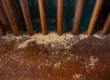
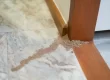
Winged termites shed their wings once they land, so small piles of identical wings on a sill or floor show that a flight has happened nearby.
Not every termite nest near a Sydney home is a threat. The Australian Museum notes that houses near bushland often have termite nests nearby, and those nests may not hold pest species. That is why a licensed inspector should confirm the species.
What to do in the first hour
- Collect a sample before you clean up: Put a few insects in a sealed jar or lift them onto clear tape, and keep some wings too.
- Photograph them: Take close photos beside a coin for scale, from above and from the side.
- Note where they appeared: A window, a light, a skirting board, a wall or the ground outside? Insects emerging inside the house matter more than those at an outdoor light.
- Leave the spot alone: Do not break open timber or dig around it, because that can make it harder for an inspector to see where they came from.
- Run the one-minute check: If it looks like flying ants, that is reassuring, but it does not rule out a separate termite problem. Visually check accessible areas such as window sills, door frames and skirting boards without disturbing any timber or suspected termite activity, then work out which ant it is.
- If you are unsure, or it looks like termites, book an inspection: Bring your photos and sample.
What a flight does and does not tell you
Winged termites come from a mature colony, but that colony may be in a neighbour’s tree stump, a garden bed or a fence post rather than your home. Insects that emerge from inside a wall, floor or skirting board point to a colony in the building, and that needs a licensed inspection soon.
Flying ants are the reproductive stage of ordinary ant colonies. They are a seasonal nuisance and do not eat timber.
Why an inspection beats guessing
Termite activity can sit hidden behind walls for a long time, and a swarm is one of the few obvious signs. A licensed inspector checks the timber, subfloor and roof void, then tells you whether there is activity and what your options are. If you have never had your home checked, read why a termite inspection matters.
If the swarm turned out to be termites, Tom’s Pest Control Sydney can inspect and explain what they find. To compare the species you may be dealing with, see our termite identification guide and the page on subterranean termites. If it was ants, our ant identification page helps you work out which kind.
Quick answers about swarms
Do flying ants damage timber?
No. Flying ants are the winged reproductive stage of ants, and they do not eat timber. A large number appearing at once is usually only a nuisance.
Does a termite swarm mean my house is infested?
Not always. The colony may be elsewhere nearby. If the insects came from inside a wall, floor or skirting board, book an inspection.
Should I spray the swarm?
Spraying will not tell you what you have, and it leaves you with fewer insects to identify. Keep a sample and photos first.
When do termites swarm in Australia?
Usually in warm, humid weather, often after rain. Timing varies by species and location, so any winged insects indoors are worth checking whenever they appear.